Managing Anxiety in High-Stakes Situations

Last Updated: November 1, 2026
Quick Summary
Managing anxiety in high-stakes moments starts with matching your tool to the channel that fires first: slow breathing with a long exhale for physical symptoms, grounding and thought challenging for racing thoughts, and preparation with a written plan for avoidance. Build a one-page pre-event plan with a recovery move, rehearse the actual task, and use a four-phase day-of protocol.
The stress response is fast, not accurate, flooding you with adrenaline and cortisol before your thinking brain catches up.
Deep breathing won't fix a thought spiral, and reframing won't slow a pounding heart, so match the tool to the symptom.
Write a one-page plan naming your worst-case story, the most likely outcome, and a recovery move for each worry.
On the day, cap caffeine at your normal amount or less, since doubling coffee can make your heart pound.
Seek professional support if anxiety interferes with work, sleep, or relationships, or if panic appears without a clear trigger.
Table of Contents
Why High-Stakes Pressure Triggers Anxiety
Your body treats a board presentation, a court appearance, or a difficult conversation with your teenager the same way it treats a physical threat. That's the core problem with anxiety in high-stakes moments: the alarm system doesn't know the difference between a bear and a performance review. (Source: the National Institute of Mental Health (NIMH))
The stress response is designed to be fast, not accurate. It floods you with adrenaline and cortisol before your thinking brain catches up. That's why your hands shake during a deposition even when you've rehearsed the answers a hundred times.
Common Anxiety Symptoms and Stress Responses
Symptoms show up in three places, and knowing which one hits you first is the key to picking the right tool.
Body: racing heart, tight chest, shallow breathing, sweating, nausea, trembling
Mind: racing thoughts, blanking out, catastrophic images, trouble concentrating
Behavior: avoidance, over-preparing, snapping at people, freezing up
A common mistake is treating all three with one technique. Deep breathing won't fix a thought spiral, and reframing won't slow a pounding heart. Match the tool to the symptom.
How to Manage Anxiety in Stressful Situations Before They Peak
The best time to manage anxiety in stressful situations is before your body has fully ramped up. Prevention beats intervention, but "prepare" isn't a strategy on its own. The useful question is: which tool do I reach for, and when?
Match the Tool to the Symptom
Anxiety shows up in three channels, body, mind, and behavior, and the channel that hits you first should determine your first tool. Using the wrong tool is the most common reason people conclude that coping techniques "don't work for me."
What you notice first | Best first tool | Why it fits | When to escalate |
Racing heart, tight chest, shallow breathing, trembling | Slow breathing with a long exhale (four in, six out) | Directly targets the physical arousal channel | Panic attacks that disrupt daily life, or chest pain that concerns you |
Racing thoughts, catastrophic images, blanking out | Grounding (5-4-3-2-1, cold water, feet on floor) and thought challenging | Pulls attention out of the future and into present sensory data | Persistent worry most days, or thoughts you can't interrupt |
Avoidance, over-preparing, snapping at people, freezing | Preparation, gradual exposure, and a written plan | Addresses the behavioral channel, which breathing and reframing don't touch | Avoidance costing you work, relationships, or health decisions |
Build a Written Pre-Event Plan
Start with a single page. Name the event, the date, and the two or three things that worry you most, then address each with a concrete action. Anxiety in high-stakes situations often feeds on uncertainty, so shrinking the unknown wherever you can may help.
Name the worst-case story. Write it in one sentence. Then write the most likely outcome next to it. The gap between the two is usually where the anxiety lives.
Plan the recovery move. For each worry, write what you will do if it happens. "If I blank, I will pause, look at my notes, and say 'let me come back to that.'" A planned recovery is more calming than a hoped-for prevention.
Set a process goal. Choose one behavior you control, pace, pauses, eye contact, a slower opening sentence, and make that the success criterion instead of the outcome.
Preparation, Practice, and Building Confidence
Preparation can help because it gives your brain evidence against the worst-case story. Practice the actual task, not just the idea of it. Rehearse out loud.
Then pull up past successes. You have handled hard things before. Write down three specific ones and read them the morning of the event. Confidence built this way is grounded in fact, not positive thinking.
Key Takeaway Before a high-stakes event, the sequence is: identify the channel that fires first, pick the matching tool, write a one-page plan that includes a recovery move, and rehearse the actual task. That sequence is what turns "I prepared" into "I have a plan for the moment it goes sideways."
Breathing Exercises for Anxiety That Work in the Moment
Slow breathing works because it signals safety to your nervous system. The goal is to make your exhale longer than your inhale.
Try this pattern:
Breathe in through your nose for four counts
Hold for two counts
Breathe out slowly for six counts
Repeat for two minutes
If counting feels awkward under pressure, use a simpler anchor: breathe in for four, out for six. The longer exhale is what matters. Practice it when you're calm so it works when you're not.
Grounding Techniques for Anxiety When Your Mind Races
Grounding techniques for anxiety pull your attention out of the future and into the room. Use them when thoughts start spiraling. (Source: the American Psychological Association (APA))
5-4-3-2-1: name five things you see, four you feel, three you hear, two you smell, one you taste
Cold water: run cool water over your wrists or hold an ice cube
Feet on floor: press both feet down and notice the pressure
These work by giving your brain concrete sensory data to process. Racing thoughts need somewhere else to go.
Performance Anxiety Coping Strategies for the Day Of
Most advice for the day of a high-stakes event is a loose list: breathe, eat, arrive early. That helps, but it doesn't tell you what to do at 6 a.m., in the five minutes before you walk in, when your voice shakes mid-sentence, or afterward so the next event is easier.

Phase 1: Morning (the job is stabilization, not motivation)
Eat a real breakfast with protein and complex carbohydrates. Low blood sugar mimics anxiety symptoms, shakiness, irritability, a racing feeling, and you will misread it as nerves.
Cap caffeine at your normal amount or less. A common pattern is doubling coffee on event days and then wondering why your heart is pounding.
Do one page of written preparation, not ten. Review your top three talking points or key facts, then close the file. Last-minute cramming raises perceived stakes without improving recall.
Phase 2: Arrival (the job is shrinking the unknown)
Arrive early enough to walk the space. Stand where you will stand, sit where you will sit, test the microphone or screen if you can. Familiarity reduces the alarm response.
Find one physical anchor: a seat, a doorway, a spot on the wall. When your mind races later, you will have a fixed point to return to.
Set one process intention, not an outcome intention. "I will slow down and pause between points" is controllable. "I will impress them" is not, and it hands your nervous system a pass/fail test.
Phase 3: During (the job is function, not elimination)
Use the long-exhale breath at natural pauses, before you begin, between sections, after a question. You do not need to hide it; a slow breath reads as composure.
If your voice shakes or your mind blanks, name it silently and slow down. A two-second pause feels enormous to you and is barely noticeable to the room.
Keep a physical grounding cue: press your feet into the floor, or rest your hands on the table and notice the pressure. This pulls attention out of the future and into the room.
Phase 4: After (the job is recovery and data collection)
Give yourself a short decompression window, a walk, a glass of water, ten minutes away from the room, before you debrief.
Write down three lines: what you did well, what you would change, and how long the anxiety took to settle afterward. That third number is your progress metric (see the tracking guidance below).
Do not replay the event with a critical lens for the rest of the day. One structured debrief is useful; rumination is not.
Pro Tip Practice the four-phase sequence on a low-stakes event first, a routine meeting, a phone call you would normally dread. The sequence works better when it is familiar, and low-stakes reps are how it becomes familiar.
Challenging Catastrophic Thoughts in the Moment
When a catastrophic thought hits, write it down or say it silently. Then ask three questions: What's the evidence? What's the most likely outcome? What would I tell a friend?
Catastrophic thoughts are predictions, not facts. Naming that gap takes away their grip. Separate the prediction from the consequence: "I will blank out" is a prediction; "and if I do, I will pause, check my notes, and continue" is a consequence you can plan for.
When Anxiety Needs Professional Support
Sometimes self-help isn't enough, and recognizing that isn't weakness. It's judgment.
Seek professional support if anxiety is interfering with work, sleep, or relationships, if you're avoiding things that matter, or if panic is showing up without a clear trigger. Research summarized through the review "Anxiety disorders" on PubMed Central found that anxiety symptoms and avoidance improved in 309 of 703 patients over six years, which shows change is possible with the right support.
If you're in crisis or having thoughts of harming yourself, call or text 988 to reach the Suicide and Crisis Lifeline.
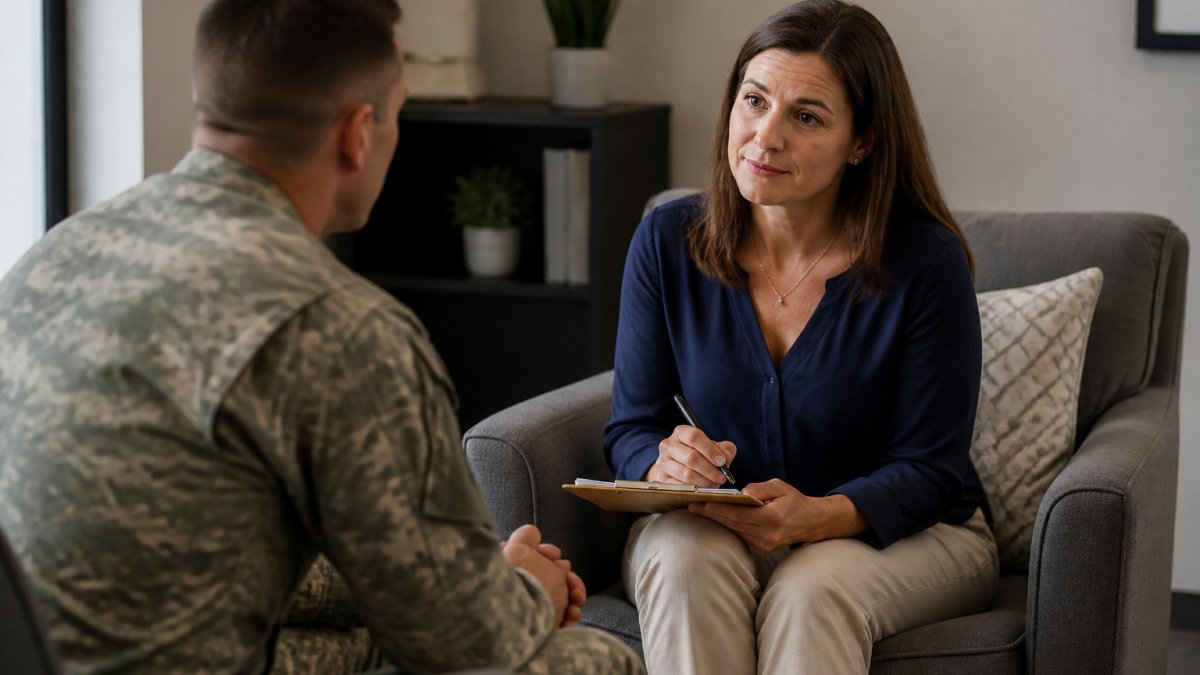
At Avenir Counseling, our team includes an Army combat veteran, a retired law enforcement officer, and a retired academic principal. You can see the counselors available to contact or review the services offered to find the right fit.
Symptom Pattern | Best First Tool | When to Escalate |
Racing heart, shallow breathing | Slow breathing with long exhale | Panic attacks that disrupt daily life |
Racing thoughts, catastrophic images | Grounding and thought challenging | Persistent worry most days |
Avoidance of key situations | Preparation and gradual exposure | Avoidance costing you work or relationships |
Frequently Asked Questions
How do you manage anxiety in high-stakes situations?
Start with a plan that covers before, during, and after the event. Beforehand, prepare thoroughly and practice under mild pressure so the moment feels familiar. In the moment, use slow breathing and grounding techniques to pull your attention back to what you can control. Afterward, review what worked and note one adjustment for next time. Research on sub-threshold anxiety suggests self-help strategies like these can be helpful and feasible for mild symptoms, though persistent or severe anxiety is worth discussing with a professional.
What can I do to calm down quickly when I feel anxious?
Try a slow breathing pattern first: inhale through your nose for a count of four, then exhale for a count of six, repeating for about a minute. Follow it with a grounding technique, such as naming five things you can see and four you can hear, to redirect attention away from catastrophic thoughts. Splashing cool water on your wrists or taking a short walk can also interrupt the stress response. These are short-term tools, not cures, so pair them with preparation and, if anxiety keeps returning, professional support.
How can I stay focused when I am under pressure?
Narrow your attention to the next single action rather than the whole outcome. Before a high-pressure conversation or decision, write down the one or two points that matter most and keep them visible. Use a brief grounding technique to reset when your mind drifts toward worst-case scenarios, and give yourself permission to pause and breathe before responding. Preparation and practice build confidence, which makes focus easier to hold. For ongoing difficulty concentrating under pressure, a therapist can help you build coping skills tailored to your situation.
When should I seek professional help for anxiety?
Consider professional support when anxiety interferes with work, relationships, or sleep, when you avoid situations you used to handle, or when self-help strategies stop helping. Research on anxiety disorders suggests that anxiety can improve with appropriate care, though outcomes vary from person to person. If you have thoughts of harming yourself or feel unable to function, seek urgent help right away. A licensed counselor can assess your situation and recommend a path forward.
You don't have to white-knuckle every high-stakes moment alone. Avenir Counseling offers a space where you feel heard, understood, and supported, with staff who have lived through pressure themselves. We help you reclaim your narrative and move toward healing and purpose. Get started with Avenir Counseling and book a session.


Comments